

Overview
If your traffic and conversion rates are solid but revenue per order feels stuck, bundling is one of the highest-leverage moves you can make. Cross-selling and category-penetration techniques yield a 20 percent jump in sales and a 30 percent increase in profits, according to McKinsey research. This guide compares three practical bundling approaches for Shopify stores: complementary product bundles, build-your-own bundles, and mix-and-match bundles. You will learn which method fits your catalog, which tools to use (from Shopify's free native app to dedicated bundle builders like Biscuits Bundles), and how to avoid common mistakes that erode margins.
Contents
The golden rule of bundling
The best bundles are not clever marketing tricks. They are products your customers already want to buy together, packaged in a way that makes the purchase easier and the value clearer. Don't bundle random products. Don't pair a slow seller with a bestseller and hope for the best.
Instead, look at what customers actually purchase in the same order. Shopify's "Items bought together" report displays the most common product combinations purchased together, so you can identify opportunities for bundles, upsells, and promotions. This report includes only processed orders as opposed to items inside of a cart prior to checkout. That real purchase data tells you which combinations already work. Your bundle just removes friction and gives customers better value on what they were going to buy anyway.
By giving the customer better value on what they actually want, you can drive real AOV growth: not inflated cart sizes that lead to returns, but genuinely larger orders from happier customers.
Side-by-side comparison: bundle strategies
Feature |
Complementary bundles |
Build-your-own bundles |
Mix-and-match / volume bundles |
|---|---|---|---|
Customer choice |
Low: curated set, variant options only |
High: customer picks items per step |
Medium: pick N from a collection |
Best for |
Routines, kits, starter sets |
Gift boxes, subscription-style, sampler packs |
Consumables, apparel, same-category products |
Setup complexity |
Low |
Medium to high |
Medium |
Typical AOV lift |
10-20% |
15-30% |
15-40% |
Common pricing model |
Fixed price or percentage off |
Sum of products, volume tiers, fixed price |
Tiered volume discount |
Shopify native app support |
Yes (fixed bundles) |
No: requires third-party app |
Partially (multipacks only) |
Example tool |
Shopify Bundles (free) |
Various bundle apps |
Complementary product bundles
Complementary bundles group a curated set of products that logically go together: a cleanser, toner, and moisturizer as a skincare routine, or a phone case and screen protector alongside a charger. Think "The Complete Skincare Routine" with cleanser, toner, and moisturizer. This works best when products naturally go together.
The psychology is straightforward. Bundling works because it triggers three powerful psychological mechanisms: perceived value, decision fatigue reduction, and loss aversion. Instead of browsing five product pages, your customer sees one curated solution at a clear price.
Strengths
Lowest setup effort: create in Shopify's free native Bundles app in minutes
Strong narrative for marketing ("Complete Your Routine," "Starter Kit")
Reduces choice paralysis by presenting a ready-made solution
Limitations
No customization for the customer beyond variant selection (size, color)
Requires you to correctly predict which products work together: get it wrong and conversion suffers
Shoppers abandon the sale when they feel forced to buy an extra item they don't need just to get a deal. Keep items individually available too
Tip: Use Shopify's "Items bought together" report to identify natural pairings before you build a complementary bundle. Data beats guesswork every time.
Build-your-own bundles
Build-your-own (BYO) bundles let the customer choose what goes in their box, step by step. People like to choose. It's that simple. When you let them build their bundle, they feel in control. They don't have to take what you picked. They get to pick what they want.
This approach works exceptionally well for gift boxes, sampler packs, or any store where customers want variety within a category. A tea shop might let customers pick 5 flavors from a list of 20. A snack brand might offer "Build your own box of 12."
Strengths
Highest engagement and customer satisfaction: shoppers feel ownership of their selection
Drives larger AOV lifts because customers tend to add more when they are actively choosing
Enables product discovery: customers explore items they might not have found on their own
Limitations
The native Shopify Bundles app doesn't support dynamic or mix-and-match bundles. For example, you cannot offer a bundle with several products from which the customer can select one variant of each class of product. You need a third-party app
More complex to set up: you need to define steps, minimums, maximums, and pricing rules
Can create fulfillment complexity with many possible combinations
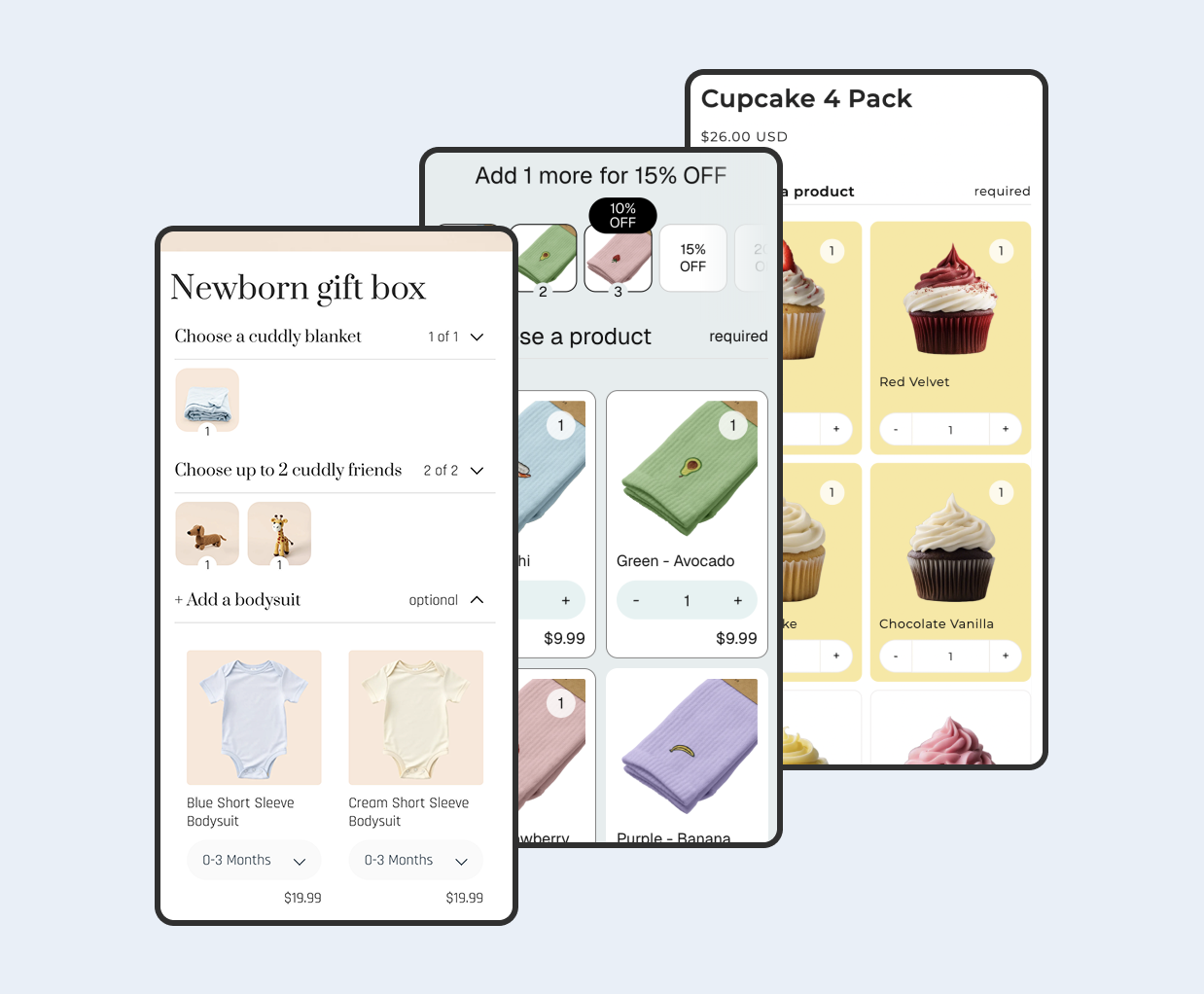
Biscuits Bundles is purpose-built for this use case. It provides a multi-step bundle builder with collapsible accordion steps, required and optional steps, single or multi-select with min/max quantities, and flexible pricing options (sum of products, fixed price, percentage or amount off, and volume discount tiers). The visual card editor lets you drag and drop products into steps, and inventory updates live so you never oversell. You can see working examples on the Biscuits Bundles demos page.
Mix-and-match and volume bundles
The customer picks items from a group. "Pick any 3 tees for $60." This gives customers freedom. It works best when you have many similar products like t-shirts, socks, or supplements in different flavors.
Volume bundles go one step further: buy more of the same product, pay less per unit. This strategy can increase AOV by 15-40% while providing genuine value to customers. The sweet spot for bundle discounts is typically 15-25% off the combined individual prices.
Strengths
Perfect for consumables and replenishment products where customers already buy in quantity
Simple value proposition: "more = cheaper per unit" needs no explanation
Tiered pricing creates a natural upsell ladder (buy 3 save 10%, buy 5 save 20%)
Limitations
Risk of cannibalizing future orders if customers stock up too far ahead
Does not work well for high-price or one-time-purchase products
Requires careful margin math: Brands with average margins of 50% or higher should offer 10-20% bundle discounts. Those with smaller margins work better with 5-10% discounts to stay profitable.
Tools comparison: native Shopify vs. bundle apps
Capability |
Shopify Bundles (free) |
Biscuits Bundles (app) |
|---|---|---|
Fixed bundles |
Yes |
Yes |
Multipacks |
Yes |
Yes |
Build-your-own / multi-step |
No |
Yes (accordion steps, required/optional) |
Mix-and-match from collection |
No |
Yes (min/max selection per step) |
Volume discount tiers |
No |
Yes |
Pricing flexibility |
Fixed price only |
Sum of products, fixed, % off, $ off, tiered |
Visual card editor |
No |
Yes (drag-and-drop, product/variant-level) |
Inventory sync |
Yes (real-time) |
Yes (live, with sold-out display options and location-based availability) |
Theme integration |
Automatic |
Theme editor app blocks (Online Store 2.0 required) |
Multi-language |
Yes |
Yes (translations support) |
Price |
Free |
Paid (see App Store listing) |
Sales channels |
Online Store, Shop, POS |
Online Store only |
Shopify's native Bundles app launched in 2023 and gets better with each update. It handles fixed bundles elegantly and costs nothing. But it has real limitations that might force you toward third-party apps or custom development. If you need customers to select their own items, define multi-step flows, or use tiered volume discounts, a dedicated app like Biscuits Bundles fills those gaps.
Side note: Biscuits Bundles requires an Online Store 2.0 theme with app blocks and is not compatible with subscriptions, purchase options, POS, or draft orders. If you sell through POS or the Shop app alongside your online store, the native Shopify Bundles app has broader channel support.
Case studies: real AOV lifts
Numbers matter more than theory. Here are documented results from Shopify merchants using bundling strategies:
HiSmile (dental care): When HiSmile implemented their bundle strategy, 80% of their orders became bundle purchases. Average cart size increased 4x.
Coconu (personal care): Coconu saw a 20% AOV increase.
Maev (pet nutrition): Maev experienced a 15% AOV lift plus a 20% jump in units per transaction.
rhode skin (skincare): Based on data compiled by Particl, company revenue from upselling kits alone rose from $948,000 to $2.53 million per month, a 2.7-times increase, from January to July 2025.
Notice the pattern: every one of these brands bundled products that naturally belong together. HiSmile pairs whitening kits with refills. rhode skin groups skincare steps into routines. The bundle just formalizes what customers already want.
Mistakes checklist: what kills bundle performance
Avoid these common pitfalls that undercut your AOV gains:
Bundling unrelated products: Bundling random products means every item in the bundle should make logical sense together. If the combination doesn't feel natural to the customer, it won't sell.
Too many bundle options: A 2024 paper on rational choice overload shows that too many options can cause people to freeze. If you offer too many bundle variations, customers may default to inaction.
Over-discounting: It's advisable to keep discounts within the range of 5% to 20% of your gross margin to maintain profitability. Deep discounts erode margins without proportionally increasing volume.
Hiding the savings: If your bundle is intended to offer a discount or value-add, it's important to display that information prominently on your product page and within your marketing efforts. Making the discount a key part of the bundle reminds shoppers they're getting a deal.
Not offering products individually: Keep your bundle menu tight, with curated options based on customer research. Let customers buy items individually so bundles feel more like a recommendation.
Launching too many bundles at once: Start with 3-5 bundles based on your most popular co-purchased products. Measure for 30 days, then expand what works.
When to use each strategy
Use complementary bundles when: you have clear product routines or kits (skincare, cooking, tech accessories), want fast setup with Shopify's free native app, and your catalog has obvious natural pairings.
Use build-your-own bundles when: you want customers to choose from your catalog (gift boxes, sampler packs, "build a box"), need multi-step flows with min/max selection, and want higher engagement and the largest AOV lifts. A tool like Biscuits Bundles handles this with its step-based builder, visual card editor, and flexible pricing.
Use mix-and-match / volume bundles when: you sell consumables or products in many variants (flavors, colors, sizes), customers naturally buy multiples, and tiered "buy more, save more" pricing makes sense for your margins.
Start with Shopify's native Bundles app when: you want to validate demand before investing in a paid app. Start with the native Bundles app even if you think you'll need more features later. Launch fixed bundles quickly, validate customer demand, then upgrade to third-party apps if needed. Most merchants overestimate their bundle complexity initially.
Verdict
Bundling is one of the most reliable ways to grow AOV without spending more on ads. The beauty of focusing on average order value is that you're concentrating on visitors who already want to buy. They've come to your site with high intent; they may even have items in their carts. All you have to do is help them discover and buy more items that are relevant to them. When you focus on engaging and activating those who are already spending with you, you have fewer barriers to overcome.
For most Shopify merchants, the smartest path is to start simple: check your "Items bought together" data, identify 3-5 natural product pairings, and launch complementary bundles with Shopify's free native app. If those bundles gain traction and you want to let customers build their own boxes with multi-step selection, volume tiers, or visual product cards, upgrade to a purpose-built app like Biscuits Bundles.
The key principle never changes: bundle the products customers actually want to buy together. Use data, not guesswork. Give them better value on what they already want, and the AOV growth follows naturally.
 View on app store